SomBank Healthcare Financing Forum
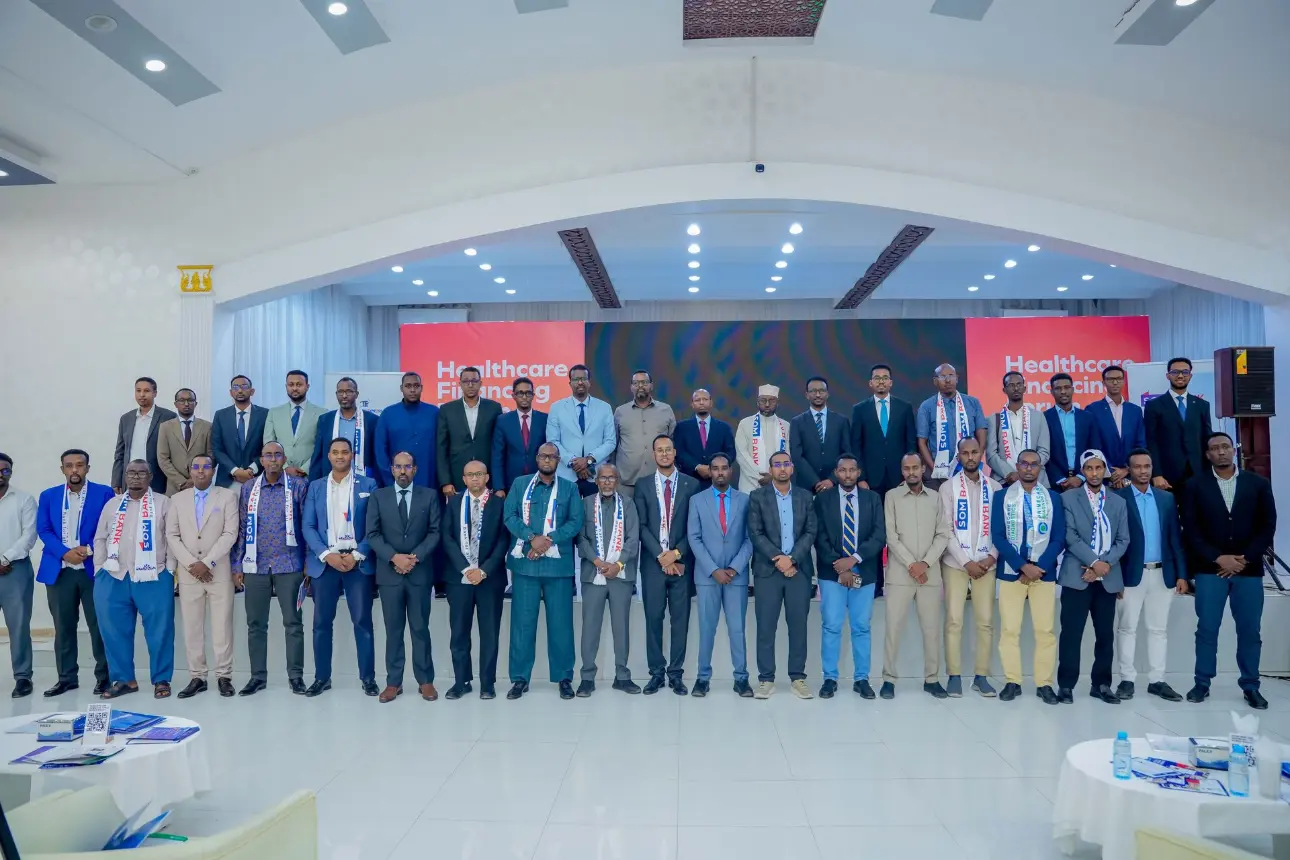
On 30 July 2026, healthcare leaders, policymakers, bankers, investors and development partners gathered at Hotel Afrik in Mogadishu around one central question: how can Somalia finance the next stage of its healthcare development?
Hosted by SomBank through the Tibyan Forum, the Healthcare Financing Forum brought together representatives from government, hospitals, clinics, pharmacies, laboratories, medical suppliers, insurers, investors, NGOs and development organizations. The intention was to bring people who usually approach healthcare from different perspectives into one room and create a serious conversation around the investment needed to improve access, quality and sustainability across Somalia’s healthcare sector.
What followed was not simply a presentation of banking products. The programme explored healthcare investment opportunities, research into the feasibility of future healthcare projects, Shariah-compliant financing, sustainable growth, and the relationship between healthcare providers, investors, policymakers and patients.
The forum helped move the discussion from a broad call for more healthcare investment toward more practical questions: Where is financing most needed? What kind of financing fits different healthcare investments? And how can institutions work together to make those investments sustainable?
From healthcare needs to investment
One of the clearest messages from the forum was that healthcare financing is not one single need.
For one institution, the priority may be a diagnostic machine or laboratory equipment. For another, it may be expanding a hospital, opening a new department or strengthening its day-to-day operations. Pharmacies and medical suppliers may face different challenges again, particularly around stock, procurement and working capital.
The forum reflected this range by highlighting financing opportunities across medical equipment, hospital expansion, working capital, payroll, supplier financing and digital payment solutions.
This broadened the discussion beyond the traditional idea of financing a hospital building or purchasing a single piece of equipment. It showed that the financial strength of a healthcare institution also depends on the systems that keep it operating its suppliers, staff, stock, payments and ability to invest continuously in better services.
SomBank also introduced Shariah-compliant structures including Murabaha, Ijara, Musharaka and Musawamah, demonstrating that different healthcare needs may require different financing approaches rather than one standard solution.
Linking financing with real healthcare demand
Another important part of the programme was the connection between investment and evidence.
Following the welcome address by Dr. Said Ali Shire, Chief Executive Officer of SomBank, Abdirizaq Bashir Hassan, Head of Investment at SomBank, presented healthcare investment and financing opportunities.
The discussion then moved from available financing to the question of where investment may actually be needed.
Mohamed H. Burci, Deputy Vice Chancellor for Administration and Finance at Puntland State University, presented a comprehensive needs assessment and market analysis for a proposed multispecialty referral hospital.
That sequence was significant. It connected capital with research.
Healthcare investment should not begin only with the question, “How much financing is available?” It also requires questions such as: What services are needed? Where are the gaps? Is there sufficient demand? What kind of facility is required? And can the investment operate sustainably over the long term?
By placing research alongside financing opportunities, the forum demonstrated the importance of making healthcare investment decisions on the basis of both need and viability.
Bringing different perspectives to one table
The central panel discussion, “Financing the Future of Healthcare in Somalia - Bridging the Gap Between Providers, Investors, and Patients,” brought together voices from banking, government, hospitals and the medical profession.
The panel included Dr. Said Ali Shire, CEO of SomBank; Dr. Abdullahi Nour Omar, Head of Policy, Planning and Coordination at the Ministry of Health and Human Services; Dr. Mohamed Abdullahi Isse, Executive Chairman of SNAPH and Member of the National Health Professionals Council; Dr. Mohamed Moalim Yakub Jimale, Admin and Finance Director at Yardimeli Specialist Hospital; Prof. Dr. Mohamud Zahid Mohamud, Internal Medicine Specialist and Hematologist; and Dr. Suleyman Abdullahi Mohamed, Co-founder of Kalkaal Hospitals. The discussion was moderated by SomBank’s Head of Investment, Abdirizaq Bashir Hassan.
The range of participants mattered because each approaches healthcare financing from a different position.
Healthcare providers understand the realities of running and expanding institutions. Policymakers consider access, regulation and the needs of the wider health system. Financial institutions examine how investments can be structured and sustained. Medical professionals see directly where shortages in equipment, services and capacity affect patient care.
Bringing those perspectives together allowed healthcare financing to be discussed not simply as a banking issue, but as a challenge shared across the sector.
Perspectives from across the sector
The wider programme added further perspectives from healthcare delivery, banking, social health protection and development organisations.
Mohamed Hussein Ashraf, Director of Erdogan Hospital, addressed the forum, followed by keynote remarks from Dr. Ahmed Khadar A. Jama, Chief Executive Officer of the Somali Bankers Association, and Dr. Abdulrazaq Yusuf Ahmed, Director General of the National Social Health Insurance Authority.
Their participation broadened the discussion beyond individual healthcare institutions. It introduced perspectives on the role of the banking sector, national health financing and the wider systems required to make healthcare more accessible and sustainable.
The forum also heard from Dr. Abdihamid I. Ahmed, Health Specialist with UNICEF, adding an international development and primary healthcare perspective to the evening’s discussions.
Together, these contributions reinforced an important theme of the event: no single institution can address Somalia’s healthcare financing needs alone. Progress depends on stronger connections between those delivering healthcare, those designing policy, those providing capital and those supporting the development of the wider health system.
A broader national perspective
The forum also welcomed HE Duale Adam Mohamed, Former Minister of Education of Somalia, who delivered one of the evening’s keynote addresses.
His participation brought a broader national development perspective to a programme largely centered on healthcare delivery and finance.
Healthcare is closely connected to the development of human capital, productivity and the strength of public institutions. Looking at healthcare investment through this wider lens helped place the discussion within Somalia’s broader development agenda rather than treating it only as a sector-specific financing issue.
The programme concluded with official closing remarks from the Ministry of Health of the Federal Republic of Somalia, reinforcing the importance of continued engagement between government, healthcare providers and financial institutions.
What the forum achieved
One of the forum’s most important achievements was making the healthcare financing conversation more concrete.
Rather than simply stating that Somalia needs more healthcare investment, the forum identified specific areas where financing can play a role from medical equipment and hospital expansion to working capital, suppliers, payroll and digital payment infrastructure.
It also connected those needs with a broader range of financing options, including Shariah-compliant structures such as Murabaha, Ijara, Musharaka and Musawamah.
A second achievement was bringing together stakeholders who influence different parts of the healthcare system. The forum created direct interaction between healthcare providers, government representatives, financial institutions, insurers, investors and development partners one of the stated objectives of the event.
Third, it brought research into the investment conversation. The multispecialty referral hospital assessment provided a practical example of how future healthcare investments can be examined through actual needs and market analysis before capital is committed.
And perhaps most importantly, the forum helped reshape the question around healthcare financing.
The conversation was no longer only:
“How can we provide more financing to healthcare?”
It became:
“What does the sector need, what should be financed, which structure is appropriate, and who needs to work together to make that investment sustainable?”
That is a more useful conversation and one that can lead to better investment decisions.
Looking ahead
SomBank established the forum with the objective of contributing to a shared national roadmap for a resilient, inclusive and well-financed healthcare system.
The significance of the Healthcare Financing Forum therefore goes beyond the presentations delivered during one evening. Its value lies in creating a platform where healthcare needs, investment opportunities, Shariah-compliant financing, policy and research could be considered together.
For SomBank, the forum also represented a continuation of its growing engagement with Somalia’s healthcare sector. It created an opportunity not only to present financing solutions, but to listen to healthcare providers, understand where investment gaps exist and strengthen relationships with the institutions shaping the sector’s future.
The Healthcare Financing Forum brought the people who understand Somalia’s healthcare needs together with those who can help finance, regulate and support the solutions. That connection is an important step toward turning healthcare priorities into sustainable investment and, ultimately, stronger healthcare institutions across Somalia.